



SMD & THT Typesetting
Technical Specifications for SMD and THT Assembly Processes
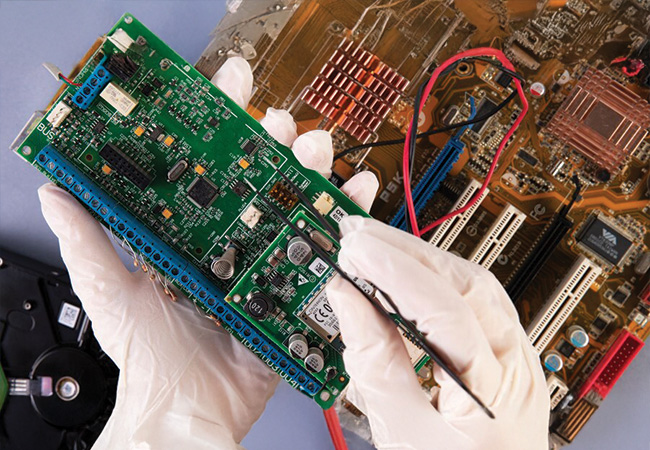
In line with the technical specifications of our SMD & THT Typesetting line, SMD and TH typesetting of all kinds of electronic cards are made in accordance with IPC-A-610 and ISO 9001 standards. Our SMD & THT typesetting line starts from our manual screen printing machine. Thanks to this machine, solder cream is applied on the PCB. Using a specially designed Stencil (Stencil) for each printed circuit board, the appropriate amount of solder cream is applied to the PCB, then it is checked and transferred to the typesetting process.
With the infrastructure we have and our staff experienced in production techniques, your cards can be designed and produced smoothly and at high quality standards without any quantity limit.
We have two separate professional lines of SMT typesetting automated machines. Up to 29,000 CPH, Juki's fast smart modular chip assembly SMT typesetting machine with class-leading speed, and 4 nozzles with 50 feeder cassettes (feeders) at appropriate coordinates, angles and heights on PCB, typesetting at a speed of 10,000 CPH according to IPC standards.
Fully Automatic SMD & THT Assembly and Soldering
Our fully automated SMD & THT Assembly Line can handle a wide range of components up to 201, 402, 603, 805, 1206, 1210 and TQFP240. The system is equipped with 4 high-resolution inspection cameras, enabling component assembly accuracy down to 0.01 millimeters, ensuring minimal error rates during assembly. After assembly and soldering, our PCB boards are rigorously inspected using the Omron RNS II Optical Inspection machine. This inspection process helps to detect and correct issues such as cold solder joints, discoloration, post-assembly oxidation and cracking.
Furnace and Heat Treatment: Precise Temperature Control
After the SMD & THT assembly process, the PCB boards are transferred via a conveyor system to a special oven. This oven offers a wide temperature range from room temperature up to 300°C and provides ±1°C temperature accuracy and ±2°C PCB temperature deviation. The furnace has a total of 12 heating zones, 6 top and 6 bottom, so that the PCB boards are baked to the required temperature profile. This process optimizes soldering quality, ensuring high standards of results.