

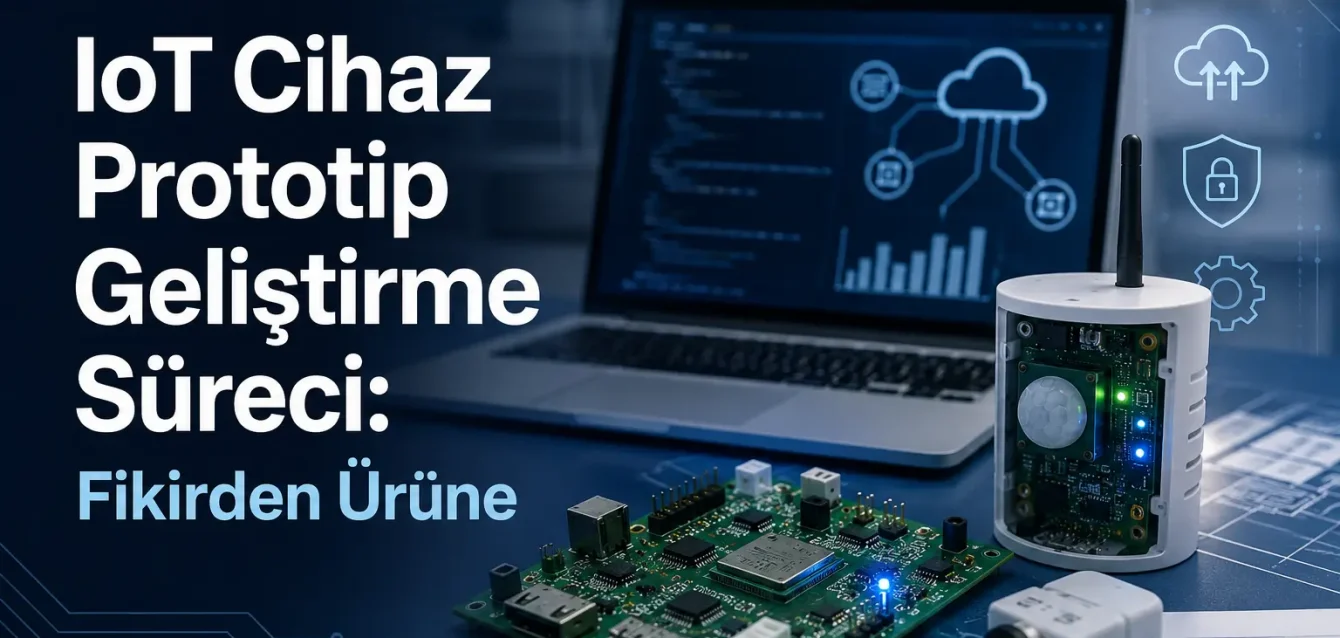
The Internet of Things (IoT) is not merely a technology that enables devices to connect to the internet; it is an ecosystem that forms the foundation of smart systems capable of collecting and analyzing data and supporting decision-making processes. From smart meters to industrial sensors, and from medical devices to smart home systems, many products are brought to market as a result of a successful prototyping process. However, developing a successful IoT product involves more than just designing electronic circuits or writing software. Proper market research, analysis of user needs, creation of an appropriate hardware and software architecture, implementation of security standards, and comprehensive testing processes are all factors that directly impact the product’s success.
What Is an IoT Device?
IoT device, are smart electronic systems capable of sensing and processing data from their surroundings and communicating with other devices or cloud platforms over the internet. Through sensors, microcontrollers, communication modules, and embedded software, they collect data from the physical world and interact with digital systems.
Today, the sensors, energy monitoring systems, smart agriculture solutions, healthcare technologies, logistics tracking devices, and building automation systems used in manufacturing facilities are the most common Internet of Things devices is among them.
The First Step in Developing a Successful IoT Product: Accurately Analyzing the Need
One of the most common mistakes in IoT projects is focusing on the technology while overlooking the actual user needs. In fact, a successful product development process begins with a proper analysis of the problem on the ground.
Different needs—such as reducing downtime on a factory’s production line, optimizing energy consumption, or enabling remote device management—require entirely different hardware and software architectures. For this reason, user expectations, the operating environment, and operational needs must be analyzed in detail before a project begins. A proper needs analysis both reduces development costs and makes it easier for the product to find a market.
Why Is Market Research So Important?
Developing a technically successful product is not, on its own, sufficient for commercial success. The target market for the product, competing solutions, user expectations, and industry trends are also an important part of the development process.
Through proper market research, it is possible to determine which problem the product being developed will solve, the expectations of the target customer base, and how it will differentiate itself from competitors. In addition, evaluating emerging technologies such as Wi-Fi 6, Bluetooth Low Energy (BLE), LoRaWAN, NB-IoT, LTE-M, and AI-powered edge computing (Edge AI) ensures that the product is better prepared for the future. Keeping up with technology trends not only provides a competitive advantage but also helps the product remain relevant for a longer period of time.
Stages of IoT Product Development
A successful IoT Product Development The process consists of complementary technical and operational steps. Carrying out these steps in a systematic manner enhances both the technical and commercial success of the product.
1. Defining the Project Objective
Every project should begin with a clear objective. At this stage, it is determined which problem the product will solve, which user group it will target, and which performance criteria it will meet. Cost targets, energy consumption, usage scenarios, and the product life cycle are also planned at this stage.
2. Hardware Design
During the hardware development process, decisions are made regarding microcontroller selection, sensors, power management, communication modules, and PCB design. The environmental conditions in which the product will be used—such as temperature, humidity, vibration, or electromagnetic interference—must also be taken into account at this stage. The right choice of components directly affects the product’s longevity and reliability.
3. Embedded Software Development
Once the hardware is complete, the embedded software that will enable the device to function is developed. Core functions such as sensor data reading, power management, communication protocols, and over-the-air (OTA) updates are implemented during this phase. The software’s modular and updatable design ensures that the product can be enhanced with new features in the future.
4. Communication and Integration Protocols
One of the most important features of an IoT device is its ability to communicate securely with other systems. For this reason, communication protocols such as MQTT, HTTP, HTTPS, Modbus, CAN Bus, BLE, Zigbee, Wi-Fi, or LoRaWAN are selected based on the use case.
Integration with cloud platforms, ERP systems, mobile apps, or industrial automation software is also planned at this stage. A robust integration infrastructure ensures that the device will operate seamlessly with various platforms for many years to come.
5. Testing and Validation
Once a prototype has been built, it is not enough for it to simply work. It must be verified that the product operates reliably under various environmental conditions.
Electrical tests, communication performance, wireless connection quality, power consumption, temperature resistance, EMC tests, and long-term operation tests are key components of this process. Cybersecurity tests also help identify potential security vulnerabilities.
6. Iteration and Product Improvement
The first prototype is rarely the final product. Improvements are made to the hardware and software based on the results of testing. Product development continues through PCB revisions, software optimizations, and user feedback. This iterative process ensures that the product reaching the market is of higher quality and more reliable.
7. Pilot Production and Transition to Mass Production
Once all validation processes are complete, pilot production begins. Pilot production allows for the testing of production processes, the implementation of quality controls, and the implementation of final improvements prior to mass production. The product is then released to the market after undergoing mass production and final product quality control processes.
A Strong Infrastructure Enables the Development of Future-Ready Products
IoT technologies are advancing at a rapid pace. Wireless connection speeds, security algorithms, and energy management solutions that were considered sufficient just a few years ago may now fall short. For this reason, the prototype development process must take into account not only current needs but also technological changes that may arise in the future.
Advances in Wi-Fi standards, new communication technologies, over-the-air software updates, battery optimization, low energy consumption, and sustainable design approaches aimed at reducing electronic waste are among the key components of next-generation IoT products.
Why Is Cybersecurity Critical for IoT Products?
Every device connected to the internet is a potential target for a cyberattack. IoT devices for which security measures have not been adequately planned can put not only their own data at risk, but also the entire network to which they are connected.
For this reason, device authentication mechanisms, end-to-end data encryption, secure communication protocols, Secure Boot, certificate management, and remote security updates have become indispensable features of modern IoT products. Compromising on manufacturing quality or opting for low-quality components, however, can lead to serious vulnerabilities in terms of both performance and data security.
Legal Standards and Regulations for IoT Devices
IoT products must not only be technically successful, but they must also comply with the legal requirements of the countries in which they will be used. Compliance with international standards—particularly regarding data security and information management—is of great importance.
In corporate information security management ISO 27001, is an important reference standard for establishing secure processes. For IoT products introduced to the European market, GDPR (General Data Protection Regulation) Obligations regarding the protection of personal data must be taken into account within this framework. In solutions developed for U.S. government agencies, however, FISMA (Federal Information Security Modernization Act) Information security requirements such as these are coming to the forefront.
Products developed in accordance with these standards not only ensure legal compliance but also instill confidence in customers and create a competitive advantage in international markets.
Conclusion
Developing a successful IoT product starts with a good idea but is brought to life through robust engineering processes. Proper market research, accurate analysis of user needs, a robust hardware and software infrastructure, reliable communication protocols, comprehensive testing processes, and compliance with international security standards are the key factors that determine a product’s success. Today, What is an IoT device? The answer to this question is no longer simply a device connected to the internet; it is smart systems that are secure, sustainable, scalable, and capable of adapting to the needs of the future. Conducting a professional product development process—from the concept phase to mass production—is critical for both technical success and commercial sustainability.
Contact Elektroent’s team of expert engineers to reliably bring your IoT project to life, from the prototyping phase through to mass production.