

After the PCB board typesetting process is completed, the boards are not delivered directly. They undergo certain tests beforehand. So which test checks what? Is it necessary to do them all?
The answers to these questions are important. Because choosing the wrong test either creates unnecessary costs or leads to defective products.
In this article, we explain the basic post-typing test methods in a simple way and clarify which one should be preferred at which stage.
Why is Post-Typing Testing Important?
You need to make sure that every board that comes out of production runs smoothly.
A small error during production can turn into a much bigger problem when it reaches the end user.
The testing process is therefore an integral part of PCB typesetting. Especially as component density increases, visual inspection alone is not enough.
What is AOI?
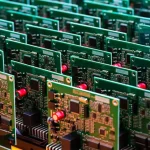
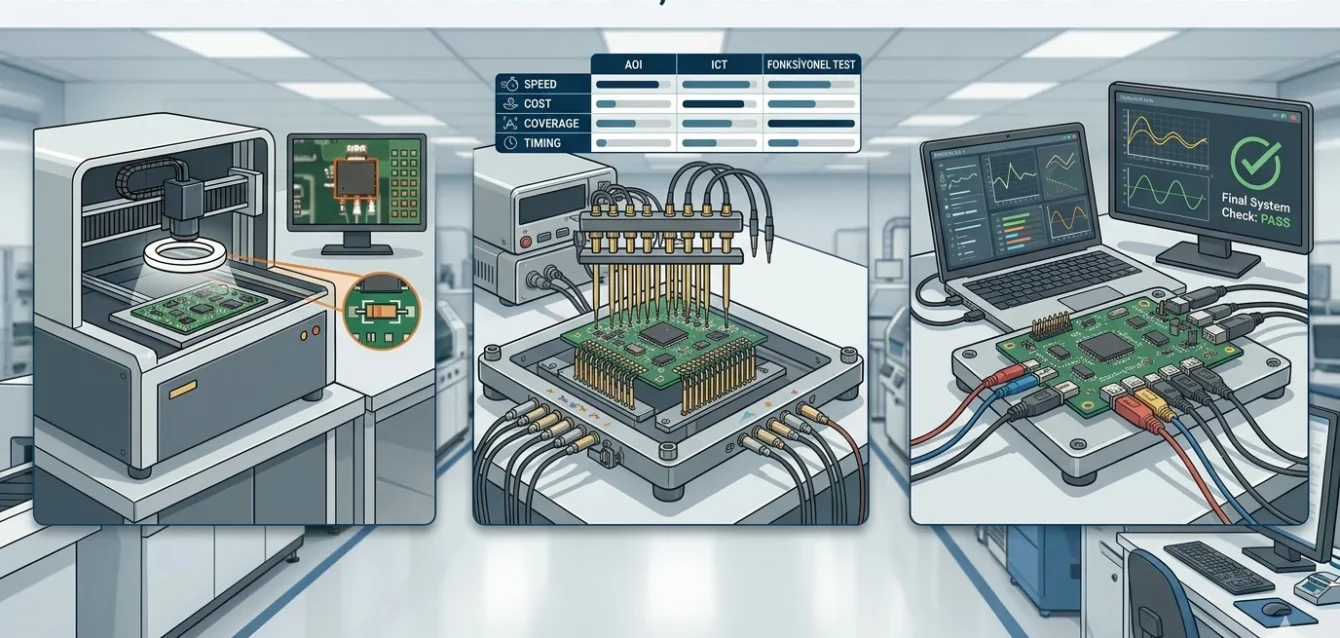
AOI is a visual inspection of the board. Each card is quickly inspected with cameras at the end of the typesetting line.
This method can detect the following:
- Missing component
- Inverted inserted parts
- Incorrect component usage
- Solder defects
- Component slippage
But AOI cannot catch everything. It doesn't know if the board is actually working, it only finds visible errors.
It is often used in both prototype and series production and is now a standard inspection method.
What is ICT?
ICT is a test that electrically checks the components on the board.
In this method, measurements are made by touching certain points on the board. This shows whether the parts have the correct values.
For example:
- Resistance and capacitor values are checked
- Short circuit or disconnection is detected
- Some faulty components are clearly found
However, this test requires a special apparatus. This means additional costs in the beginning.
Therefore, it is generally preferred for high volume production.
What is a Flying Probe?
Flying probe is a test method similar to ICT but more flexible.
No special apparatus required. Test leads measure by touching the points on the board in sequence.
The advantage is that it is very practical in low quantity production. It adapts quickly even if the design changes.
The disadvantage is that it is slow. It is not preferred for high volume production.
It is therefore often used in prototyping and low-volume typesetting processes.
What is Functional Testing?
The functional test checks whether the board actually works.
That is, the card is energized and checked to see if it does what is expected.
For example:
- Does the device turn on
- Are the sensors giving accurate data
- Is the communication working properly
This test reveals some faults that other methods fail to catch. But it requires special setup for each product.
It is generally preferred for more critical products.
Which Test Should You Use and When?
Each test meets a different need. It is not enough on its own.
The general approach could be as follows:
- Fast and flexible solutions are preferred during the prototype phase.
- The flying probe stands out in low quantity productions.
- ICT becomes more efficient in high volume production.
- In mass production, AOI is almost always used.
If the product is critical, functional testing is added to the process.
As Elektroent, we determine the appropriate test methods for the production process together and manage the post-typing control processes with confidence. Together we can determine the right approach for your project.
[email protected] | +90 (216) 466 46 37