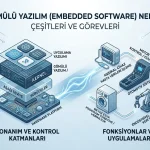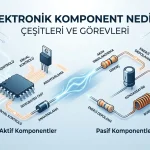


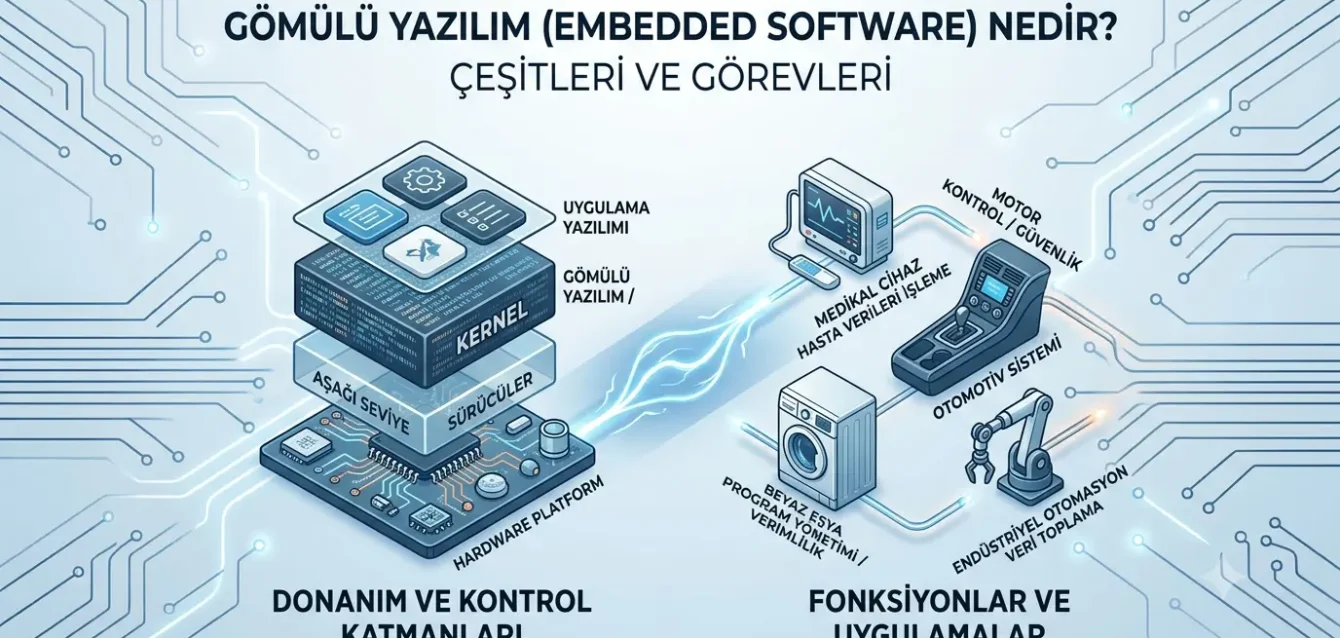
Embedded software refers to specialized software systems that run inside electronic devices and control the hardware. It is one of the fundamental building blocks that enables many of the electronic products we use today to become “smart.” From smartphones to home appliances, and from automotive systems to industrial devices, many technologies operate thanks to embedded software. For this reason, embedded software is considered one of the most critical components of the modern electronic world.
What Is Embedded Software?
Embedded software is a type of software developed specifically for a particular electronic device and designed solely to enable that device to perform its functions. Unlike general-purpose software, it is designed for a single function or system and runs directly on the hardware. It operates in microcontroller- or microprocessor-based systems and manages the device’s entire control mechanism.
Thanks to embedded software, a device detects commands from the user, collects data from sensors, and processes this data to produce the correct output. This structure is particularly important in real-time systems.
Its Relationship with Embedded Systems
Embedded systems are integrated structures in which hardware and embedded software work together. These systems combine sensors, processors, and electronic components, and the layer that manages the entire process is the embedded software. While hardware alone does not perform any function, embedded software makes it operational and intelligent.
For example, in a washing machine, adjusting the water level, controlling the motor speed, and selecting a program are all managed entirely by embedded software. Similarly, in a car, the braking system, the engine control unit, and the safety systems also operate using embedded software.
Where Is Embedded Software Used?
Embedded software has a very wide range of applications today. In the automotive industry, it is used in vehicle control systems, engine management, and safety technologies. In home appliances, it provides energy management and program control. In industrial automation systems, it controls production lines.
It also manages data collection, wireless communication, and remote control processes in IoT (Internet of Things) devices. Medical devices, defense industry systems, and smart devices are other key areas where embedded software is actively used.
The Importance of Embedded Software in Electronic Products
The key element that enables electronic products to become “smart devices” is embedded software. The same hardware can perform completely different functions depending on the software used. This demonstrates just how critical software is in product development processes.
Embedded software enables devices to operate faster, consume less energy, and be more reliable. It plays an indispensable role, particularly in Industry 4.0, the Internet of Things (IoT), and automation systems.
Conclusion
Embedded software is the core technology at the heart of modern electronic systems; it controls the hardware and enables devices to function. Today, many electronic products operate and become “smart” thanks to embedded systems.